Article: Pet Urn Size Guide: How to Choose the Right Urn for Your Dog or Cat
Pet Urn Size Guide: How to Choose the Right Urn for Your Dog or Cat
Introduction
One of the first questions families ask after choosing cremation is surprisingly practical:
"What size pet urn do I need?"
It's also one of the easiest questions to overthink.
Some people worry about buying an urn that's too small.
Others assume bigger is always better.
The truth is that choosing the right pet urn size is usually much simpler once you understand how cremated remains are measured.
A few basic guidelines can help you choose with confidence while avoiding the uncertainty that many families experience.
In this guide, you'll learn:
- How pet urn capacity is measured
- How your pet's weight affects urn size
- Why extra space is often recommended
- The difference between dog and cat urn sizing
- When you should consider choosing the next size up
- Common sizing mistakes to avoid
By the end, you'll have a much clearer idea of what size urn will comfortably hold your pet's ashes and fit naturally in your home.
Quick Answer: What Size Pet Urn Do I Need?
For most pets, choosing the right urn comes down to your pet's weight before cremation and the urn's internal capacity.
As a general industry guideline:
1 pound (0.45 kg) of body weight before cremation ≈ 1 cubic inch of urn capacity.
This rule works well for most dogs and cats and is the standard used by many crematories and urn manufacturers.
However, it should be treated as a starting point rather than an exact formula.
Several factors can affect the final volume of cremated remains, including:
- Your pet's bone structure
- The cremation method
- The crematory's processing procedure
- Whether you plan to place a keepsake inside the urn
Because of these variables, many families choose an urn with 10–20% more capacity than the estimated minimum.
A little extra space is usually more reassuring than discovering the urn is too small.
Quick Reference Size Chart
| Your Pet's Weight | Minimum Capacity | Recommended Capacity |
|---|---|---|
| Up to 10 lbs | 10 cu in | 12–15 cu in |
| 10–20 lbs | 20 cu in | 22–25 cu in |
| 20–35 lbs | 35 cu in | 38–42 cu in |
| 35–50 lbs | 50 cu in | 55–60 cu in |
| 50–70 lbs | 70 cu in | 75–80 cu in |
| 70–100 lbs | 100 cu in | 105–115 cu in |
| Over 100 lbs | 110+ cu in | Choose the next available size |
Remember: If you're choosing between two sizes, the larger one is usually the safer option.
For cats, most fall into the Small category.
How Pet Urn Capacity Actually Works
Many first-time buyers assume urn size refers to the outside dimensions.
It doesn't.
What matters is the internal capacity, which is measured in cubic inches.
Two urns that look almost identical on the outside may hold very different amounts of ashes depending on:
- Wall thickness
- Material
- Interior construction
- Decorative design
This is why relying only on photos can sometimes be misleading.
Always check the listed capacity before making a decision.
Why Ashes Don't Fill the Entire Urn
Another common misunderstanding is that an urn should be completely full.
In reality, that's not how most urns are designed.
A little empty space inside the urn is completely normal.
Many families intentionally leave room for:
- A lock of fur
- A folded letter
- A small memorial note
- A tiny keepsake
- A piece of your pet's favorite blanket or bandana
Choosing an urn that has a small amount of extra capacity often makes it easier to include these personal touches without feeling crowded.
Why We Usually Recommend Choosing Slightly Larger
One of the questions we hear most often is:
"Should I buy the exact size or go one size larger?"
In most situations, choosing slightly larger provides more flexibility.
For example:
A dog weighing 48 lbs may technically fit into a 48 cubic inch urn.
However, many families would feel more comfortable choosing a 55–60 cubic inch urn instead.
The difference in appearance is often small, but the additional space provides reassurance.
The same applies to cats.
A cat weighing 12 lbs may only require a 12 cubic inch urn, but selecting a 15–20 cubic inch urn usually feels more comfortable without looking oversized.
The goal isn't to buy the biggest urn available.
It's simply to avoid unnecessary stress during an already emotional time.
Which Weight Should You Use?
Another question that causes confusion is:
"Should I use my pet's current weight or their healthy weight?"
The answer is simple.
Always use your pet's weight immediately before cremation whenever possible.
That is the measurement crematories generally use when estimating ash volume.
If you don't know the exact number, an approximate weight is usually enough.
For example:
- Your veterinarian may have a recent weight on record.
- Your cremation provider may be able to tell you.
- Even estimating within a few pounds is usually sufficient.
If you're between two estimates, choosing the larger capacity is generally the safer decision.
Dogs and Cats Don't Always Follow the Same Pattern
Although the "1 pound = 1 cubic inch" guideline applies to both dogs and cats, there are small differences worth knowing.
Large-breed dogs tend to have heavier bone structures than similarly sized breeds, which can result in slightly more cremated remains.
Cats, on the other hand, usually fall very close to the standard guideline.
This is why breed alone isn't enough.
A lean Greyhound and a stocky Bulldog may weigh the same but have different body structures.
Likewise, two Maine Coon cats can vary significantly in weight.
Your pet's actual body weight is always more useful than breed when choosing an urn.

Dog Urn Size Examples
Sometimes real-life examples are easier to understand than charts.
Here are a few common situations.
Example 1
Golden Retriever — 68 lbs
Recommended capacity: 75–80 cubic inches
Example 2
Labrador Retriever — 82 lbs
Recommended capacity: 90–110 cubic inches
Example 3
French Bulldog — 26 lbs
Recommended capacity: 30–35 cubic inches
Example 4
Chihuahua — 7 lbs
Recommended capacity: 10–12 cubic inches
Example 5
German Shepherd — 92 lbs
Recommended capacity: 100–110 cubic inches
If your dog's weight falls close to the upper end of a range, choosing the next size up is usually the safest option.
For more breed-specific guidance, you can also read:
- What Size Urn Do I Need for My Dog?
- What Size Urn for a 50 lb Dog?
- What Size Urn for a 70 lb Dog?
- What Size Urn for a 100 lb Dog?
Cat Urn Size Examples
Cats are often easier to size because most cats fall within a smaller weight range.
However, the same rule still applies:
Choose the urn based on your cat's actual weight, not only breed or appearance.
A smaller-looking cat may have a larger bone structure, while a larger-looking cat may weigh less than expected.
Here are some common examples.
Example 1
Domestic Shorthair Cat — 8 lbs
Recommended capacity:
10–12 cubic inches
Example 2
Ragdoll Cat — 15 lbs
Recommended capacity:
15–20 cubic inches
Example 3
Maine Coon Cat — 18–22 lbs
Recommended capacity:
22–30 cubic inches
Example 4
Senior Cat — 10 lbs
Recommended capacity:
12–15 cubic inches
For more specific examples, you can also read our dedicated guide:
What Size Urn Do I Need for My Cat?
Why Cremation Method Can Affect Ash Volume
Many families do not realize that the cremation process itself can influence the final amount of cremated remains.
The most common question is:
"Will my pet's ashes always match the estimate?"
The answer is:
Not always.
The 1 pound = 1 cubic inch guideline is useful, but the final amount can vary slightly depending on several factors.
Flame Cremation
Traditional flame-based cremation is one of the most common methods.
During this process:
- The body is exposed to high heat
- Organic material is removed
- Remaining bone fragments are processed into cremated remains
Because bone density varies between pets, the final amount may differ slightly.
Water-Based Cremation
Some families choose water-based cremation, also known as alkaline hydrolysis.
This process uses:
- Water
- Heat
- Alkaline solution
The process differs from flame cremation, and some families prefer it because of its gentler approach.
The resulting remains may have differences in appearance and volume compared with traditional cremation.
Your pet's memory deserves more than a shoebox.
Handcrafted urns, made to honor the bond that never fades.
View Our Urns →Should Cremation Method Change the Urn Size You Choose?
Usually, you do not need to make a completely different calculation.
However, if you know your pet's cremation method, it can be helpful information when choosing between two sizes.
If you are unsure, selecting the slightly larger option provides additional reassurance.
For more information about cremation methods, you can read:
Water-Based vs Flame Pet Cremation: What's the Difference?
What If My Pet's Ashes Don't Fit in the Urn?
This is one of the biggest fears families have before ordering.
Many people imagine opening the urn and discovering that the ashes cannot fit.
Fortunately, this situation is uncommon when the size is chosen carefully.
If an urn feels too small, possible solutions may include:
- Choosing a larger urn
- Using a companion urn or keepsake urn
- Selecting another memorial container
- Speaking with the cremation provider about options
The best way to avoid this situation is simple:
Do not choose based only on the outside appearance of the urn.
Always check:
- Capacity
- Pet weight recommendation
- Interior dimensions
Why Choosing Slightly Larger Can Provide Peace of Mind
Many families tell us that the emotional concern is not the extra space.
It is the fear of not having enough.
A slightly larger urn often creates more confidence because you know there is room if the estimate is slightly different.
This is especially helpful for:
- Larger dogs
- Older pets
- Pets with heavier bone structures
- Families who want to include small keepsakes
If you are worried about this situation, our guide on What If My Pet Urn Is Too Small? explains what options families have.
Can You Put Keepsakes Inside a Pet Urn?
This is another question many families ask.
The answer depends on the design of the urn and your personal preference.
Some families choose to keep only ashes inside.
Others include small symbolic items such as:
- A handwritten note
- A small piece of fur
- A tiny photo
- A fabric piece from a favorite toy
- A small collar tag
However, it is important to remember that not every urn is designed for extra items.
Before adding anything inside, consider:
- Available space
- The urn opening size
- Whether the item is safe for long-term storage
For many families, keeping keepsakes beside the urn rather than inside it is also a meaningful choice.
A memorial corner with a photo, collar, candle, or paw print can create a beautiful place of remembrance.
You can find more ideas here:
What Do People Put Next to a Pet Urn?

Choosing the right size depends on more than just weight.
Common Situations Families Ask About
"My dog is between two size ranges. Which one should I choose?"
Choose the larger option.
Being slightly above the recommended capacity is usually more comfortable than being below it.
"My pet was very small. Do I still need to worry about size?"
Yes, but small urns are usually easier to select.
Even for small pets, always check capacity instead of choosing only by appearance.
"Can siblings or multiple pets share one urn?"
Some families choose companion memorial options.
If you are considering this, the required capacity will depend on the combined estimated amount of cremated remains.
"Do larger urns look too big for smaller pets?"
Not necessarily.
A well-designed urn can still look appropriate even if it has extra capacity.
The style, shape, and display location often influence the overall feeling more than the size alone.
How Size and Design Work Together
Size is important.
But it is not the only factor.
The urn you choose also needs to feel right visually.
A large urn may need a more open display space.
A smaller urn may work beautifully on a shelf, bedside table, or memorial corner.
This is why choosing an urn is a balance between:
- Capacity
- Design
- Material
- Personal meaning
- Home placement
The right urn should work both practically and emotionally.
8. Common Mistakes When Choosing a Pet Urn Size
Most sizing problems don't happen because the calculations are difficult.
They happen because families are making decisions during an emotional time.
Knowing the most common mistakes can help you avoid unnecessary stress.
Mistake 1: Choosing Based Only on the Outside Size
One of the biggest misconceptions is assuming that a larger-looking urn always holds more ashes.
In reality, two urns with similar exterior dimensions can have very different internal capacities.
Wall thickness, decorative details, and construction all affect how much space is available inside.
Whenever possible, check the listed internal capacity (cubic inches) rather than relying only on photos.
Mistake 2: Forgetting to Leave a Little Extra Room
Many families focus on finding the exact minimum capacity.
While this usually works, choosing a little extra space often provides more flexibility.
Additional room can be helpful if you would like to keep:
- A small lock of fur
- A handwritten note
- A tiny keepsake
- A piece of your pet's favorite blanket
An urn does not need to be completely full to be appropriate.
Mistake 3: Using Breed Instead of Weight
Mistake 4: Ignoring Where the Urn Will Be Displayed
An urn becomes part of your home.
Before ordering, consider:
- Shelf depth
- Cabinet height
- Available space
- Nearby photographs or keepsakes
A practical size should fit comfortably into the place where the memorial will live.

Pet urn placed in a home memorial setting with flowers candle and framed photo
9. How to Feel Confident About Your Choice
Many families worry that they'll choose the wrong urn.
In reality, there usually isn't a single perfect answer.
The right urn is simply the one that gives you confidence when you imagine bringing it home.
Before placing your order, take one final moment to ask yourself:
- Does the size feel appropriate?
- Am I comfortable with the material?
- Does the style reflect how I want to remember my pet?
- Will it fit naturally where I plan to display it?
- If it's personalized, do I have the photos and information ready?
If the answer to most of these questions is "yes," you're probably making the right decision.
Finding the Right Balance Between Practicality and Emotion
Choosing a pet urn is one of those decisions where practical details and emotions naturally come together.
Capacity matters.
Measurements matter.
But they are only part of the decision.
The memorial should also feel like it belongs in your home and reflects the relationship you shared with your pet.
Some families choose a simple ceramic urn with only a name engraved.
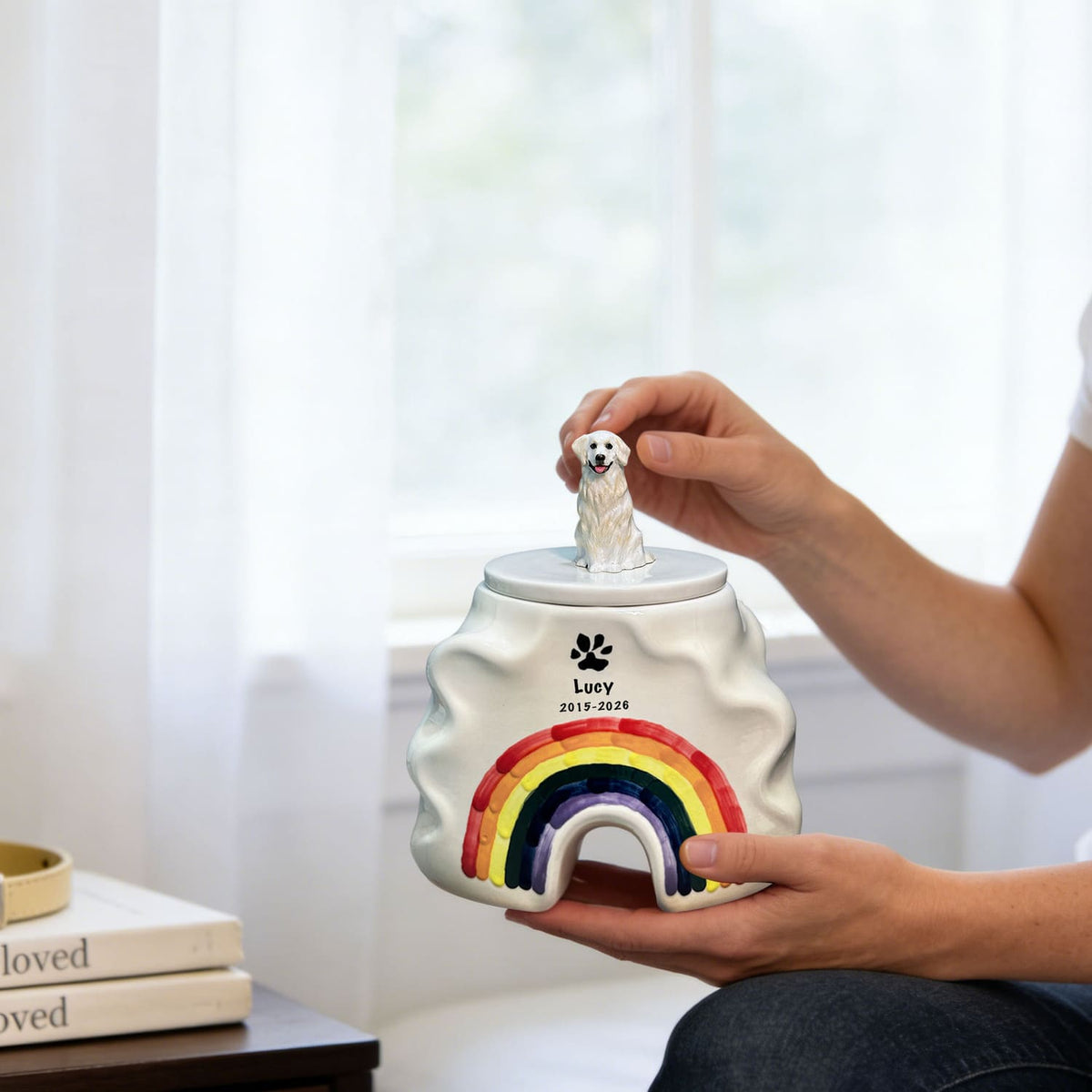
Others prefer a handcrafted memorial inspired by favorite photographs.
Neither approach is more meaningful than the other.
The best choice is the one that feels right every time you see it.

Handmade ceramic custom pet urn collection with personalized details and figurines
Final Thoughts
Choosing the correct pet urn size is easier than it first appears.
Start with your pet's weight before cremation.
Allow a little extra capacity if you're between sizes.
Think about where the urn will live in your home.
Then choose a memorial that feels appropriate for the way you want to remember your companion.
The measurements help you make a practical decision.
The memories help you make the right one.
If you're ready to explore handcrafted memorials, you can browse our collections of Custom Pet Urns and Personalized Pet Urns to compare different styles for dogs and cats.
Frequently Asked Questions
How do I calculate the right pet urn size?
A common guideline is to choose an urn with about 1 cubic inch of capacity for every pound of your pet's body weight before cremation. Choosing slightly more capacity is often recommended.
Should I choose a larger pet urn?
If your pet's weight falls between two size ranges, choosing the larger urn is usually the safer option and provides extra flexibility.
Do dogs and cats need different urn sizes?
The sizing principle is the same, but dogs often vary more in bone structure and body weight. Always choose based on your individual pet rather than breed alone.
Does water-based cremation change the urn size?
It can slightly affect the final volume of cremated remains. If you're unsure, choosing the next size up usually provides peace of mind.
Can I keep a collar or lock of fur inside the urn?
Some urns have enough internal space for small keepsakes, while others do not. Always check the internal capacity and opening size before placing additional items inside.
What happens if the urn is too small?
If the ashes do not comfortably fit, you may need a larger urn or an additional keepsake urn. Choosing the correct capacity beforehand is the best way to avoid this situation.
Can I use the same urn for two pets?
Yes, but only if the urn has enough capacity for the combined cremated remains. Many families also choose companion urns designed specifically for two pets.
Is urn capacity more important than the outside dimensions?
Yes. The internal capacity determines whether the urn can safely hold the cremated remains. Exterior dimensions alone are not a reliable guide.